Live Traffic Feed

Sunday, December 18, 2005

"Welcome to the 2006 FIFA World Cup Germany™"
Seventeen years after the fall of the Berlin wall, a reunified Germany will throw open its doors to the world. Germany 2006 will be a place where people from all around the world will be welcomed by friends, in the spirit of the striking slogan chosen by the organisers: Die Welt zu Gast bei Freunden.
The tournament is being held on the finest stage in the world, one whose symbolism far transcends the boundaries of sport. Hark back to Germany’s triumph at the 1954 FIFA World Cup in Switzerland, which sealed the country’s return to the international fold in the most beautiful manner possible.
In 2006, Germans will have the opportunity to rectify certain clichés and preconceived ideas. The world will have the chance to see what a fantastic country Germany truly is: the beauty and diversity of its landscapes, its rich cultural heritage and the intelligence and good humour of its people.
As for the legendary German work ethic and organisational skills, I am pleased to say those perennial qualities are alive and well - and we at FIFA are only too happy to take advantage of them.
For at all levels, the overall investment in any World Cup tournament is immense. The event is financially supported by the German state, but also by the “Länder” and the Host Cities. I would like to take this opportunity to offer my heartfelt thanks to all those who are currently working with such passion and commitment to make the occasion a memorable one.
Today’s efforts will bear fruit tomorrow. German football, for example, will boast twelve spanking new or vastly improved stadiums in 2006. The whole German population too will benefit in terms of better transport and reception infrastructures.
Football clubs, schools and people all over the land have really got behind this great event, providing further proof, if any were needed, of the prominent role football plays in all our lives. In this respect I would like to congratulate the German Football Association for inviting people from all walks of live to take part in this great event.
Needless to say, none of this comes as a surprise and I am well aware of the loyalty of the Deutscher Fussball-Bund* and its President, my good friend Gerhard Mayer-Vorfelder. They enjoy my complete confidence in their ability to organise a tournament every bit as good as in 1974.
Like Mexico, Italy and France, Germany is now organising its second FIFA World Cup. The first saw the great Franz Beckenbauer lift the trophy as captain of the winning team. Today, he presides over the Local Organising Committee in the run-up to a tournament which has changed considerably down the years: back in 1974, only sixteen sides took part, including the now-defunct German Democratic Republic (GDR) and Zaire. The latter were the only representative from the African continent and conceded fourteen goals with no reply.
The 2006 tournament will be a vastly different affair. Thirty-two teams will have qualified, including five from Africa, all of whom now perform at a far higher level. Just remember how Senegal upset the odds in Korea and Japan in 2002. The same can be said for Asian teams, who produced a semi-finalist last year, something which would have been unthinkable back in 1974!
These performances bear witness to FIFA’s efforts in the last quarter of a century to help the nations of the football world to compete on an equal footing. I will have the immense pleasure of welcoming you amongst my friends in Germany. We look forward to seeing you in 2006 to celebrate this unity!
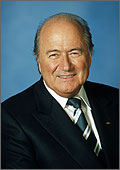
Joseph S. BlatterFIFA President

Wednesday, December 14, 2005

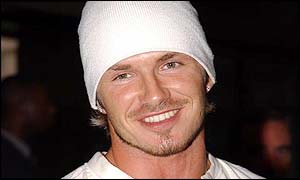
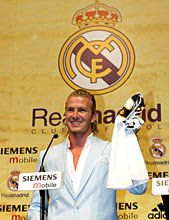
David Beckham


Full Name: David Robert Joseph Beckham
Birthplace: Leytonstone, 2/5/1975
Zodiac Sign: Taurus
Hair: Light Brown Eyes: Dark Blue
Scar: Left Cheek
Height: 180cm - 5ft 11in Weight: 67kg - 10st 8lb
Family: Parents Sandra & Ted, sisters Joanne & Lynne
Wife: Victoria Caroline Adams Beckham
Sons: Brooklyn Joseph Beckham, Romeo Beckham

Full International: England (58 caps, 10 goals)
Position: Midfield
Squad Number: 23
Appearances (1992-2000): 387
Goals Scored with Club: 81
Signed On: 29-01-1993

World Cup Groups

Fixtures
Group stages
FRIDAY 9 JUNE Group A Germany v Costa Rica 1700, Munich Poland v Ecuador 2000, Gelsenkirchen

SATURDAY 10 JUNE Group B England v Paraguay 1400, Frankfurt Trinidad & Tobago v Sweden 1700, Dortmund

Group C Argentina v Ivory Coast 2000, Hamburg
SUNDAY 11 JUNE

Group C Serbia & Montenegro v Holland 1400, Leipzig

Group D Mexico v Iran 1700, Nuremberg Angola v Portugal 2000, Cologne
MONDAY 12 JUNE

Group F Australia v Japan 1400, Kaiserslautern


Group E USA v Czech Republic 1700, Gelsenkirchen Italy v Ghana 2000, Hanover
TUESDAY 13 JUNE

Group G South Korea v Togo 1400, Frankfurt France v Switzerland m1700, Stuttgart

Group F Brazil v Croatia 2000, Berlin
WEDNESDAY 14 JUNE

Group H Spain v Ukraine 1400, Leipzig Tunisia v Saudi Arabia 1700, Munich

Group A Germany v Poland 2000, Dortmund
THURSDAY 15 JUNE

Group AEcuador v Costa Rica 1400, Hamburg

Group BEngland v Trinidad & Tobago 1700, Nuremberg Sweden v Paraguay 2000, Berlin
FRIDAY 16 JUNE

Group C Argentina v Serbia & Montenegro 1400, Gelsenkirchen Holland v Ivory Coast 1700, Stuttgart
Group D Mexico v Angola 2000, Hanover
SATURDAY 17 JUNE

Group D Portugal v Iran 1400, Frankfurt

Group E Italy v USA 1700, Kaiserslautern Czech Republic v Ghana 2000, Cologne
SUNDAY 18 JUNE

Group F Japan v Croatia 1400, Nuremberg Brazil v Australia 1700, Munich

Group G France v South Korea 2000, Leipzig
MONDAY 19 JUNE

Group G Togo v Switzerland 1400, Dortmund

Group H Saudi Arabia v Ukraine 1700, Hamburg Spain v Tunisia 2000, Stuttgart
TUESDAY 20 JUNE

Group A Ecuador v Germany 1500, Berlin Costa Rica v Poland 1500, Hanover

Group B Sweden v England 2000, Cologne Paraguay v Trinidad & Tobago 2000, Kaiserslautern
WEDNESDAY 21 JUNE

Group D Portugal v Mexico 1500, Gelsenkirchen Iran v Angola 1500, Leipzig

Group C Holland v Argentina 2000, Frankfurt Ivory Coast v Serbia & Montenegro 2000, Munich
THURSDAY 22 JUNE

Group E Czech Republic v Italy 1500, HamburgGhana v USA 1500, Nuremberg

Group F Japan v Brazil 2000, Dortmund Croatia v Australia 2000, Stuttgart
FRIDAY 23 JUNE

Group H Saudi Arabia v Spain 1500, Kaiserslautern Ukraine v Tunisia 1500, Berlin

Group G Togo v France 2000, Cologne Switzerland v South Korea 2000, Hanover


Knockout stages
SATURDAY 24 JUNEGame One:Winner Group A v Runner-up Group B 1600, Munich

Game Two:Winner Group C v Runner-up Group D 2000, Leipzig

SUNDAY 25 JUNEGame Three:Winner Group B v Runner-up Group A 1600, Stuttgart

Game Four:Winner Group D v Runner-up Group C 2000, Nuremberg

MONDAY 26 JUNEGame Five:Winner Group E v Runner-up Group F 1600, Kaiserslautern

Game Six:Winner Group G v Runner-up Group H 2000, Cologne

TUESDAY 27 JUNEGame Seven:Winner Group F v Runner-up Group E 1600, Dortmund

Game Eight:Winner Group H v Runner-up Group G 2000, Hanover

FRIDAY 30 JUNEQuarter-Final One:Winner Game One v Winner Game Two 1600, Berlin

Quarter-Final Two:Winner Game Five v Winner Game Six 2000, Hamburg

SATURDAY 1 JULYQuarter-Final Three:Winner Game Three v Winner Game Four 1600, Gelsenkirchen

Quarter-Final Four:Winner Game Seven v Winner Game Eight 2000, Frankfurt

TUESDAY 4 JULYSemi-Final One:Winner Quarter-Final One v Winner Quarter-Final Two 2000, Dortmund

WEDNESDAY 5 JULYSemi-Final Two:Winner Quarter-Final Three v Winner Quarter-Final Four 2000, Munich

SATURDAY 8 JULYThird/Fourth place play-off:Loser Semi-Final One v Loser Semi-Final Two 2000, Stuttgart

SUNDAY 9 JULYFinal:Winner Semi-Final One v Winner Semi-Final Two 1900, Berlin


Let the phoney war begin. Hostilities will not commence for another six months, but the opponents are known, along with the battle grounds.
Paraguay, Trinidad and Tobago and Sweden lie in wait and Sven-Goran Eriksson already has his troops in position.
NealSimpson/Empics
For better or worse Peter Crouch remains Sven's only plan B.
Indeed, to hazard a guess, he has as many as 20 players pencilled in. Injury permitting, a summer in Germany awaits for them. Excellent news for those players, the beneficiaries of continuity of selection, but a move that threatens the late arrival in the squad, once an intriguing ingredient of any major tournament, with extinction.
And this is to be lamented. The surprise package has had a catalytic role in previous England campaigns. Four years ago, it was Trevor Sinclair, the unlikely and, as it turned out, brief solution to Eriksson's left-sided problems. In 1990, David Platt's prolific form for Aston Villa propelled him into the squad, and he swivelled to volley England into the quarter-finals.
And though home advantage gave Sir Alf Ramsey the luxury of more time to prepare for the 1966 World Cup, few had inked in Martin Peters, Alan Ball and Geoff Hurst for pivotal roles in the preceding months. Ramsey's wonders, meanwhile, only became wingless during the group stage.
In 2004, Eriksson appeared to determine selection during his long winter break. It was to the detriment of Jermain Defoe and Shaun Wright-Phillips, whose visible sharpness in the second half of the season earned them accolades, but not squad places in Portugal.
They were the form players, but Darius Vassell and Kieron Dyer were preferred, though Eriksson has subsequently admitted he should have opted for Defoe. Now, in a reversal of fortunes, they could profit from a similarly early choice. They are now the men in possession, albeit when consigned to the bench for both club and country.
Two years on, the Swede should not make the same mistake. However, in his defence, he has little scope for experimentation. England have just three more matches, and only one before May. It provides scant opportunity to state a case, even for the most eloquent of footballers. Nor, however, have Eriksson's friendlies provided the ideal environment for contenders.
His first 11 is almost finalised, the sole debating point being the final midfield position contested by Ledley King and Joe Cole. In his reserves, Eriksson appears to favour loyalty, versatility and youth, perhaps scarred by Gareth Southgate's recollections of the campaign in Japan. Those who have not complained about their bit-part roles in the qualifying campaign, therefore, are in pole position.
And much as their managers champion their causes, the wannabes should be aware that even squad members in the current England party have considerable job security.
Stuart Pearce has been vocal about the resurgent Vassell, but Defoe has understudied Michael Owen since Euro 2004. James Beattie, with a blend of optimism and naivety has spoken about making it difficult for Eriksson to ignore him, but the Swede, like Rafael Benitez, stood by Peter Crouch during his lengthy goal drought. His late appearance against Argentina - while Owen struck twice - surely cemented his place; Steve Bruce's pleas on behalf of Emile Heskey must be in vain.
And once discarded, there is rarely a reprieve; Eriksson, it seems, does have a steely side. Only David James has returned, and that owes much to the lack of English goalkeepers. Chris Kirkland, should he stay fit, seems a certainty. Robert Green, meanwhile, behind one of the Championship's leakier defences, may be grateful that he is not in the limelight.
In defence, the FA must have been instructed to take the suit measurements of the first-choice back four of Gary Neville, Rio Ferdinand, John Terry and Ashley Cole plus King, Sol Campbell and Luke Young, now firmly established as the deputy at right back.
JonBuckle/Empics
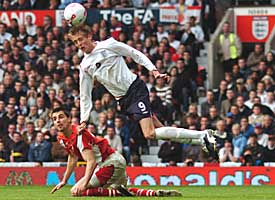
Parker's combative performances for Newcastle may yet book him a seat of the plane to Germany.
Were Eriksson's wishes granted, Wayne Bridge would be joining them. But he now appears to be Chelsea's third-choice left back, providing an incentive for Paul Konchesky and Kieran Richardson, while the adaptability of Phil Neville and Jamie Carragher makes them other options. At the back, the only wild card is Jonathan Woodgate, whose fitness cannot be taken for granted, but who is the only outsider who could complicate Eriksson's thinking.
In midfield, David Beckham, Frank Lampard and Steven Gerrard are the untouchables, and Joe Cole completes a quartet of automatic selections.
Wright-Phillips and Jermaine Jenas can expect a ticket to Germany as a reward for whiling away hours on the bench. It leaves two positions up for grabs in perhaps the only area where Eriksson is open to persuasion. One, however, may be delegated to another defensive player as both Neville and King are options as an anchor midfielder. So, too, is Michael Carrick, so impressive in the USA last summer, but off the international stage since then.
And for the final spot, in the interests of balance, a left-footer has appeal. Richardson has become a regular in the squad but Stewart Downing, currently sidelined, but capped by Eriksson, would be the more adventurous option.
But for those outside the squad - a category that current includes the Middlesbrough winger - the prognosis is not so healthy. Darren Bent, Kevin Nolan, Michael Dawson and Teddy Sheringham will all have their advocates, but the strongest challenge is coming from Tyneside where Scott Parker's commitment is not for the squeamish.
His all-round excellence has attracted widespread admiration but not, seemingly, from the England manager. But Eriksson may need to heed his late charge to prove his squad has not become a closed shop - and, after the errors caused by premature selection in 2004, perhaps to provide the spark to ignite England's World Cup challenge